


The Chancellor has ignored calls from the industry to reduce the current 20% VAT rate for hospitality, despite last-minute lobbying from MPs, business organisations and even chefs.
In October, Lagan Valley MP Sorcha Eastwood launched a UK-wide parliamentary petition calling for a cut to VAT for pubs, cafes, and restaurants, while members of the Scottish Hospitality Group also urged the UK Government to cut VAT. Michelin-starred chef Heston Blumenthal was also involved, calling on the government to reduce VAT and do more to stem the closure of pubs in the UK.
UKHospitality meanwhile had launched an online tool in September enabling hospitality teams to write to their MP, urging Government action to support the sector at the forthcoming Budget. The initiative is part of the trade body’s ongoing #TaxedOut campaign, which highlights the damaging impact of the current tax burden on hospitality businesses.
At the time of launch, Kate Nicholls, Chair of UKHospitality, said: “We know how passionately people who work in hospitality feel about the sector, so this new tool allows them to join the campaign, too. There are millions of people that have built a career in this sector and, critically, rely on it for employment and supporting their families. It’s so important that they can make their voice heard.
“I urge everyone involved in hospitality to share this tool with their teams and encourage them to write to their MPs. By uniting our voices, we can send a clear message to the Government that the hospitality sector is being taxed out and needs urgent support in the forthcoming Budget.”
UK versus Europe
With no VAT reduction announced in last month’s Budget, those in hospitality may feel they have been left with very little support. Paul Hammond, partner, indirect tax at accountants and business advisory firm Cowgills says potential measures could have included reduced VAT on specific services – such as food served in pubs. While any support in this area would have been strongly welcomed by clients in the hospitality industry, any changes such as these were perhaps more of a long shot than anything else, as they would have depended on whether they could have been funded elsewhere.
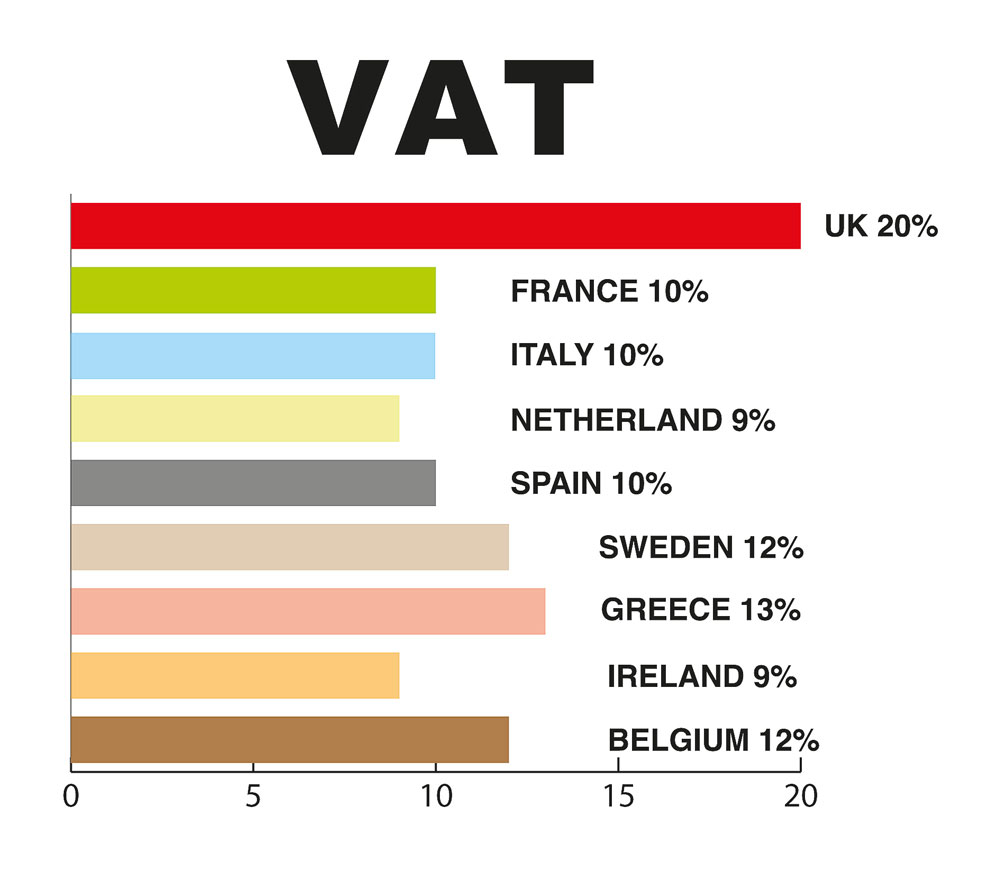
The Budget may be over for another year, but the industry believes there is still very much a case for reduced VAT for hospitality businesses such as restaurants and takeaways. At 20%, the UK has one of the highest rates of VAT for hospitality in Europe. In France, Spain and Italy, it stands at 10%, in the Netherlands it is 9%, in Belgium 12% and in Sweden, 12%. In Ireland, the VAT rate is 13.5%, but this will be reduced to 9% from July 2026, a measure announced as part of the Irish Budget 2026 and intended to support the sector.
Industry leaders believe a VAT cut would stimulate the economy, boost tourism, and help businesses grappling with rising costs. As Adrian Markey, managing director at Adrian Markey Chartered Accountants explains, hospitality, more than most other business models, has a huge gap between the amount of VAT that it has to pay and the amount of VAT that is possible to reclaim.
“This huge gap leaves [margins] in hospitality very tight,” he says. “Parallel to that, hospitality is an industry where there’s very little autonomy for businesses to change prices. For smaller, independent operators, prices are set for them in the market, within a tight range, which is another strain [to bear].”
Oli Khan, president of the Bangladesh Caterers Association (BCA) says having a lower rate of VAT makes eating out and ordering takeaways relatively cheaper, which tends to increase footfall and turnover in a sector with thin margins. The BCA has issued press statements and campaigned publicly about the VAT issue, highlighting closures in the sector and urging political parties and the government to consider targeted support, including tax relief and easier access to skilled staff.
“It stimulates demand and reduces consumer prices – this was the core rationale when the UK introduced temporary VAT cuts during Covid,” he says. “A lower rate can also protect jobs and business viability. Hospitality is labour-intensive and many operators – especially small, independent restaurants and takeaways, have low cash buffers; a lower VAT can help avoid closures and job losses.”
As Khan points out, Indian restaurants and takeaways typically operate on tight margins and a higher VAT rate is contributing to closures and consolidation.
“Multiple industry articles and trade bodies have recorded closures in the curry/ Indian-restaurant sector and hospitality more widely over recent years,” he says. “Higher tax burdens (VAT plus rising energy, labour, business rates) are flagged as one of the contributing factors. The sector has seen longstanding structural pressures (staff shortages, Brexit-related costs, rising food prices) and VAT increases add to that burden.
Future outlook
Speaking before the Budget was revealed, Markey said he didn’t envisage measures that will tackle the VAT rate explicitly.
“I just do not see any changes to VAT coming, when the public finances are in the state they’re in,” he says. “All the rumours we are hearing about the Autumn Budget is a hike in National Insurance, and that employers and companies are probably going to be stung for a lot of the gaps in the public finances.”
Khan says the future outlook for hospitality VAT is ‘politically contested and uncertain in the UK’.
“There is active pressure from trade bodies, such as UKHospitality, the Restaurants Association and others for a reduced or lower temporary VAT to help the sector, but the Treasury must balance lost revenue and wider fiscal priorities,” he says. “That means change is possible (especially around budgets) but not guaranteed.”
He suggests two likely policy paths might happen in the short to medium term: targeted temporary cuts (such as short-term VAT reductions during recessions or to stimulate demand), or a permanent sectoral reclassification (a lasting reduced rate for hospitality), which is politically harder and more costly to justify.
Ultimately, he acknowledges, any VAT change’s real effect depends on how much of the tax cut is passed to consumers and whether it’s targeted to the right sub-sectors (such as excluding alcohol or delivery).
With the Autumn Budget delivering a resounding ‘no’ to the hospitality industry with regards to reduced VAT, it’s a case, once again, of wait and see.
———-
The Budget at a glance

There was no reduction in the VAT rate for hospitality in this year’s Budget, but other policies that will impact the industry were announced. These include changes to minimum pay and business rates. Chancellor Rachel Reeves confirmed plans to introduce permanent lower business rates tax rates for over 750,000 retail, hospitality and leisure properties, worth nearly £900m a year from April 2026. The multipliers for retail, hospitality and leisure properties will be 5p below their national equivalents.
Increases to the National Living Wage were also announced. It is set to rise by 50p an hour to £12.71 from April 2026, equivalent to an extra £900 a year for a full-time worker. The minimum wage for 18- to 20-year-olds will increase by 85p to £10.85 per hour.
In response to the Budget, UKHospitality said that wage rises, holiday taxes and steep increases in rateable values are ‘wiping out’ the 5p business rates discount for hospitality.
Kate Nicholls, Chair of UKHospitality, said: “A 5p business rates discount is simply not enough to offset these costs and redress the damage it will do to business viability and job opportunities. This is exactly why we called for the Government to use the maximum possible discount it had the power to implement, which could have genuinely delivered lower business rates. Instead, we have a situation where hospitality businesses are checking their wage bills and rateable values, and their hearts are sinking at the eye-watering increases before them.”